GreenEyedGuide Caffeine Challenge Day 2/10 – Wake Up SANS CAFFEINE

For Day 2 of the GreenEyedGuide Caffeine Challenge, we review tricks for waking up without caffeine: Water-swishing, hand-pinching, and more!

WHY THIS IS HELPFUL

Ever been stuck in a conference or meeting or lecture where you feel yourself getting sleepy and don’t have any caffeine? These tricks can help in those awkward moments.

WHY THIS IS IMPORTANT

If you always reach for caffeine when you start feeling sluggish, you might end up having caffeine in some circumstances where you don’t REALLY need it. Having a few tricks to help yourself wake up without caffeine can help you avoid building caffeine tolerance or dependence.

Through this caffeine challenge, you’ll learn how to use the 5 Levels of Fatigue to reap the benefits of caffeine while avoiding addiction, dependence, tolerance, and toxicity.

PLAY ALONG – post a picture of your WAKE-UP tool/trick on Instagram and tag @GreenEyedGuide

How does caffeine affect weight loss and physical activity? Book Excerpt of the Week

How does caffeine affect weight loss and physical activity? Caffeine encourages several small metabolic changes, and all these changes encourage the use of fat for fuel instead of glucose. But how does caffeine trigger all these small changes? The answer has to do with adenosine’s throne.

Okay, so let’s say that adenosine has a throne that only adenosine can fit into. When adenosine sits on its throne, it can send signals to make us sleepy. Fortunately for us, caffeine is similar enough in size to fit adenosine’s special throne. When that happens, caffeine blocks adenosine, preventing those sleepy signals from being sent. But adenosine has more than one throne. In fact, we have adenosine receptors all over the body. Interacting with all those adenosine receptors is how caffeine is able to trigger these small metabolic changes that encourage fat-burning over glucose-burning for fuel.

This fat-burning boost sounds awesome! But there is one more thing about caffeine and physical activity we need to consider: the effect on blood pressure. This brings us to the Excerpt of the Week:
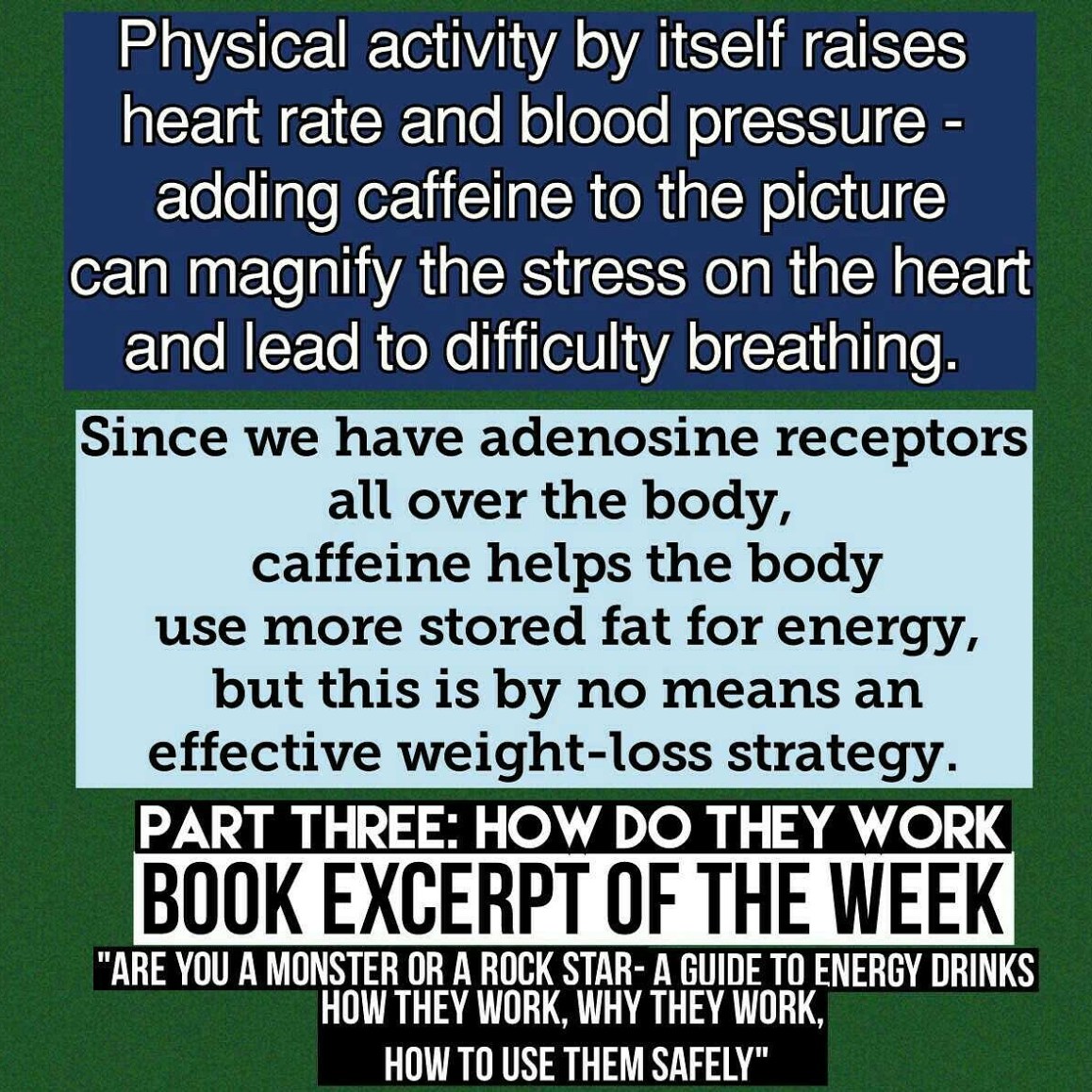
Both caffeine and exercise raise heart rate and blood pressure, so combining them can have a scary, additive effect. In general, 200 mg caffeine per “sitting” or occasion is considered safe by multiple sources, including the EFSA. But if you’ve never consumed a pre-workout supplement or other source of caffeine before a workout before, start small.

We’ll talk MUCH MORE about caffeine and fat metabolism/weight-loss when we get to the GREEN TEA section of this book. For now, let me just say that no one should expect an energy drink to be a safe or effective weight-loss method. If an energy drink helps you make it to your workout, that’s a different story. Remember – caffeine is not a miracle weight loss tool!

When is the last time you saw a story or post about someone who lost weight because they started drinking Product X?  Unless it comes with a diet and exercise regime, you can ignore that story.

An energy drink may give you wings, but it will not make you lighter all by itself.

You can get your copy of “Are You a Monster or a Rock Star-A Guide to Energy Drinks: How They Work, Why They Work, How to Use Them Safely” on Amazon and wherever books are sold.

💥 💚📚 http://amzn.to/2bjHRbk
Stay tuned for next week’s book excerpt, as we continue to move page-by-page through the Energy Drink Guide.

Don’t forget – you can follow GreenEyedGuide on InstagramFacebook, and Twitter!

Coffee and Chlorogenic Acid- Book Excerpt of the Week 

This excerpt comes from PART THREE of my book, where I talk about the science behind energy drink ingredients! 

Large studies involving thousands of people across multiple countries have shown the risk of type 2 diabetes mellitus decreases as coffee consumption increases. [Higdon, J.F. and B.Frei.2006. Coffee and Health: A Review of Recent Human Research. Critical Reviews in Food Science and Nutrition 46:101-123]

We haven’t done a deep-dive here on GreenEyedGuide to discuss chlorogenic acid, but it’s worth noting chlorogenic acid might be one reason for the coffee/diabetes association:

Stay tuned for next weeks’s excerpt, posted every Monday here, on Instagram.com/greeneyedguide and Facebook.com/energydrinkguide 

You can get your copy at Amazon [amzn.to/2bjHRbk] and wherever books are sold.

Check out this sweet Instagram shout-out from GreenEyedGuide fan @frankchills:

“Awww! 🤓📚💚📕🎁📖 #Repost @frankchills with @repostapp

Big shout out to @greeneyedguide for providing me with a copy of her book… like her instagram the book is filled with numerous facts about energy drinks down to their ingredients. Again thank you for this!”

Why is caffeine in headache medicine? Book Excerpt of the Week 

Caffeine is a vasodilator, meaning it makes your blood vessels slightly larger in diameter. However, that’s not the case for your whole body.

For the Book Excerpt of the Week, we look at why caffeine is often included in some pain and headache medications. 

Stay tuned for the next Book Excerpt of the Week from “Are You a Monster or a Rock Star-A Guide to Energy Drinks: How They Work, Why They Work, How to Use Them Safely”, available on Amazon and wherever books are sold. 

Mr. Swift and Mr. Thrift: Book Excerpt of the Week 

HOW QUICKLY you consume caffeine is JUST AS IMPORTANT as HOW MUCH caffeine you consume. 

❎This is why I don’t like energy shots! If it’s more caffeine than you can handle, it’s too late because you’ve consumed the whole thing in one gulp.❎ 

Sipping your caffeine and even breaking the 1 can = 1 serving suggestion (treating 1 can = 4 servings) you can decrease the total amount of caffeine you consume in one day and ultimately teach your body to work just as well with slightly smaller doses. 

Consider the Book Excerpt of the Week from PART TWO: Do They Work Energy – Synergy and the WHO, HOW, and WHEN 

Mr. Thrift sips his caffeine throughout the day to make it last. Mr. Swift makes sure to drink every last drop of a 16 ounce can containing 160 mg caffeine on his way to work. By the end of his shift, he feels like he needs another can. With caffeine’s half-life of ~4 hours, there is still ~80 mg  in Mr. Swift’s system. However, with his consumption habits, this won’t feel like enough. 

Story Time

When I was in grad school I would drink a full bottle of water, then pour half my energy drink in that empty bottle and save it for the next day. The carbonated energy drinks would lose all the carbonation overnight, but I didn’t care. The caffeine still worked. To this day, I rarely finish a whole energy drink in one day. Those days that I do, it’s a long drawn out consumption, to ensure I don’t consume more caffeine than I absolutely need. 

Get your copy of my book, “Are You a Monster or a Rock Star-A Guide to Energy Drinks: How They Work, Why They Work, How to Use Them Safely” on Amazon and wherever books are sold.