Science Behind Clean Energy Organics

This is one of those times that reminds me of a South Park episode: when I use the words “clean energy” to describe a healthy alternative to the stereotypical energy drink, my computer starts showing me ads for solar power. As suggested in the South Park episode “Sponsored Content”, ads have evolved. But then so have energy drinks.

The Energy Drink of the Month for April 2016 is Clean Energy On-Demand (CEO).

clean energy on demand CEO greeneyedguide energydrink
Clean Energy On-Demand – YET ANOTHER Energy Drink in Disguise!

Currently, Watermelon Coconut is the only flavor available, but this product is brand new as of this post. For an in-depth Q & A with Founder Jason Petrou, including their Steven Covey-eque Mission Statement and a peak into just how difficult it can be to bring a healthy beverage to market, CLICK HERE.

THE CAFFEINE

This product contains 70 milligrams of caffeine per bottle, and it says so right on the label. The caffeine comes from organic green coffee beans — Arabica coffee beans that are spared from the roasting that turns them brown and delivers the signature coffee flavor profile. Of course, caffeine is caffeine is caffeine, but that’s specifically the molecule itself. When caffeine is extracted from different sources, different compounds may come along with it – sometimes called conjoiners. This is why a food scientist may find different microscopic compounds mixed in with their caffeine extract if that extract comes from a coffee bean or a coffeeberry.

Thankfully CEO treats one whole bottle as one whole serving (how realistic), but with a screw-cap lid you can moderate your dosage and save some for the next day. This 70 mg dose of caffeine is slightly less than the 80 mg in an 8 oz Red Bull and less than HALF that of a SHORT cup of brewed coffee from Starbucks. (PS – Please note that using “a standard cup of coffee” as an indicator of caffeine content is one of the worst measurement devices on the planet.  Those who respect your business will tell you EXACTLY how much caffeine is in their product without hiding behind this euphemistic, deceptive measurement. )

5 levels of fatigue greeneyedguide
The 5 Levels of Fatigue provides guidelines for matching caffeine content and other factors (like carbonation) with how tired you ACTUALLY are.

THE INGREDIENTS

Other ingredients in this product include watermelon juice concentrate, coconut water concentrate, and lime juice. These ingredients and the corresponding sodium and potassium electrolytes are what make this drink so refreshing and hydrating.  [For more on hydration, see this article from Food Insight]

There are no artificial colors or flavors in this product, and no added sugar. The watermelon juice provides the sweetness, and vegetable juice is added to enhance the drink’s slight red hue.

The most chemical-sounding ingredients in this product are sodium citrate and malic acid, but even those are very clean and non-scary to the worst case of chemophobia. Sodium citrate is a form of the citric acid that gives lemons their characteristic sourness, and malic acid is naturally found in watermelons and stone fruits. See this amazing infographic from Compound Interest for more details on those natural acids:

http://www.compoundchem.com/2016/02/25/a-guide-to-common-fruit-acids/
Common Fruit Acids: http://www.compoundchem.com/2016/02/25/a-guide-to-common-fruit-acids/

THE COMPARISONS

Not all energy drinks are created equal, and whether an energy drink is right for you depends not just on your level of fatigue, but on your diet goals and lifestyle choices. For example, some people are more concerned about artificial ingredients than their sugar intake, while others would rather have stevia or artificial sweeteners and a zero-sugar, zero-calorie beverage.

CEO v Similar Energy Drinks

CEO has no artificial colors or flavors, and each bottle contains just 50 Calories and 11 grams of sugar. Even if you drank the whole bottle, the sugar and Calorie impact is still minimal, which makes this energy drink a great healthy swap for some of the strictest diets. Compared to Starbucks Refreshers, which is also made with green coffee beans, this CEO beverage has more juice and caffeine (50%, 70 mg versus 25%, 50 mg). CEO also has less sugar than both Starbucks Refreshers (11 grams versus 13 grams).

Compared to BAI Antioxidant Infusion, which we reviewed February 2016, CEO has more sugar (11 grams versus 2* grams). However, that 2-asterisk-grams doesn’t include the 16 grams of sugar alcohol erythritol per bottle of BAI. CEO doesn’t use any sugar alcohols (or any other sweeteners for that matter). Furthermore, CEO is 50% juice per bottle and is aimed at hydration, while BAI is only 8% juice per bottle and is aimed at providing a dose of coffeeberry antioxidants.

CEO v Similar Hydration Drinks

I, personally, cannot stand the taste of coconut water. If you enjoy coconut water and are interested in other hydration drinks, CEO is worth a try. It bothers me immensely when people group energy drinks into one giant basket. Thus I will not make that mistake here with coconut waters. Instead, I will advise you to compare labels for Calories and sugar content when finding the beverage that works best for your diet goals and lifestyle. First and foremost you should find a sports drink that doesn’t cause you any tummy discomfort or sabotage your whole day, diet-wise. The next step in finding the perfect hydration beverage is to find one you will actually drink! For more on hydration, see this handy guide I prepared for The Scientific Parent.

BOTTOM LINE

Behold – yet another “energy drink in disguise” that breaks the energy drink stereotype. I wouldn’t recommend this product unless I was confident in its safety – and I do highly recommend this product. I got the chance to ask CEO about their food safety program and quality testing, and I am satisfied that this is a safe, healthy alternative to the stereotypical energy drink. At 70 mg per bottle, this would make a great swap to those used to the caffeine of a single 8 ounce Red Bull.

Unless you live in Boston, you can get this drink here on the CEO site.

CEO on Facebook on Instagram and on Twitter

CEO featured in Food Navigator’s “Beverage Entrepreneurs and Trends to Watch”

~GreenEyedGuide

—————————————–

ENERGY DRINK OF THE MONTH YEAR IN REVIEW (YEAR 1 AND YEAR 2)

Explore the CAFFEINE INFORMER database

Visit the Energy Drink Guide Facebook page (sooo close to 100 Likes!)
Follow the GreenEyedGuide on Twitter
Follow GreenEyedGuide-the-NPC-Figure-Athlete on Instagram and Tumblr

Get your copy of “Are You a Monster or a Rock Star: A Guide to Energy Drinks — How They Work, Why They Work, How to Use Them Safely”

Science Behind Bai Antioxidant Infusion

Bai Antioxidant Infusion is one of those “energy drinks in disguise” I love reviewing because it breaks the norm AND withstands a food scientist’s ingredient scrutiny. Bai Antioxidant Infusion (HENCEFORTH ‘B.A.I.’) is an “energy drink in disguise’ with only 35 mg caffeine, and a novel blend of white tea, polyphenols, and coffeefruit extract. Coffeefruit is not an ingredient many people have heard of, but its story of discovery is a shining example to those concerned about food waste. After reviewing the food science of B.A.I.’s most interesting ingredients, we’ll compare the “healthiness” of this product to other tea-based beverages and similar energy drinks.

Read more

Sugar Free Energy Drink Comparison – Spider Energy vs Rockstar vs Monster

In this post, we take a close look at the ingredients in sugar free Spider Energy in comparison to similar products from Monster Energy and Rockstar Energy. Our deep-dive comparison includes the ingredients used, their function, and whether any of these are better for people trying to avoid certain ingredients.

Sugar Free Energy Drink Comparison: Spider Energy, Rockstar Energy, and Monster Energy

What We’re Comparing

  • Ingredient Line Deep Dive
    • Which ingredients are used and why?
    • How similar are the ingredients?
  • Bottom Line and Biggest Differences
    • Are any of them better or worse for people trying to avoid certain ingredients?

Ingredient Line Deep Dive includes:

  • Ingredient Order
  • Caffeine Content
  • Vitamin Dosage
  • Other Actives (ginseng, guarana, carnitine, etc.)
  • Sweetness Profile
  • Other Ingredients (colors, thickeners, preservatives, etc.)

Thank you all!

Science Behind Spider Energy Mimic

Summer is the best time to try new things, whether it’s exploring a new city or sampling new food. This month’s pick is one I wouldn’t normally try but felt compelled by the gorgeous design to give it a shot.

The Energy Drink of the Month for June 2015 is Spider Energy Mimic.

It’s just hitting stores now, June 2015, and a sugar-free version will be released later this year. (Check out this bold label – I can’t wait! I love the graphics!) No, this drink is not called Mimic because it is trying to mimic another energy drink that starts with letter M. If anything, the taste is closer to original Red Bull than original Rockstar or original Monster, but Spider Mimic is more tangy-fruity than either of those.

GREEN-EYED INSIGHT on SPIDER ENERGY MIMIC

What’s In It and Why?

This energy drink has no artificial colors or flavors, no high-fructose corn syrup or artificial sweeteners. It is sweetened with sucrose and glucose only, which accounts for its unique tart sweetness. If you are less concerned with overall sugar intake and more concerned about HFCS, and artificial colors/flavors/sweeteners, Spider Energy is more favorable than many other similar energy drinks. (No judgments – we all have different diet goals and needs)

Spider Energy Mimic Fact Panel

The B-vitamin complex is represented, but thankfully Spider does not go crazy with the amounts. Yes, B-vitamins are water-soluble but more isn’t always better (I’ve discussed the consequences of too much niacin or vitamin B6 elsewhere).

From a quality assurance/food safety perspective, I’m glad Spider Energy Mimic uses extracts (Panax Ginseng Extract, Guarana Seed Extract, Green Tea Extract). In general, extracts contain more of the active and less of the background (inherent microbial growth and heavy metal content).

I also love that this label opted to include a chart of the actives. That’s a great way to empower your consumers, letting them know exactly what actives are in your product, at what amounts. Speaking of empowering consumers, the details about what all these actives do is captured in the Energy Drink Guide; to avoid repeating myself or minimizing the years of work that went into said guide, I’ll just encourage you to check this guide out. It is the ultimate resource to all things energy drink and caffeine safety.

Who and What is This For?

This whole can provides 55 grams of sugar, which is too much for many people (including myself). But you can share with a friend or consume only half the can one day, saving the rest for later.

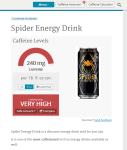
This whole can provides 240 milligrams of caffeine so, with the sugar content and carbonation, by the 5 Levels of Fatigue system, this product is a Level 4: a serious boost that’s best reserved for energy emergencies than for everyday consumption. If you’re working two jobs, if you’re pulling all-nighters to move out of your apartment by the deadline, or it’s your turn to stay up all night scouring the city and fighting crime, this drink is appropriate. If you consume this drink multiple times a week you may be getting your body too used to large amounts of caffeine.

NOTE – According to the European Food Safety Authority, a single dose of 200mg caffeine, with a daily maximum dose of up to 400mg caffeine is considered safe. But I personally recommend that caffeine consumers try to get by on as little caffeine as possible, so that when you REALLY need it, the caffeine will be able to do its job. This is what the 5 Levels of Fatigue is all about – finding the drink with the attributes that match how tired you are, preventing over-consumption and dependence.

Meet Your Friendly Neighborhood Spider Energy

Founded in 2009 under The Masters of Beverages, Spider Energy strives to be better than the “Big 3”. With a specific call-out to each on their main page, the main mission of Spider was captured perfectly in the following announcement from BevNet:

http://www.bevnet.com/news/2009/10-19-2009-spider_energy

 Bottom Line

Spider Energy Mimic is not for everyone. Energy drinks, in general, are not for everyone, but even this particular energy drink is not for all energy drink consumers. It has a cleaner ingredient line than many of its competitors, so if the sugar is too much for you (and my nifty little trick in the video above doesn’t appeal to you), I HIGHLY recommend seeking the Sugar-Free Mimic, coming soon.

REFERENCES AND RELATED LINKS

Spider Energy Home

From: http://www.caffeineinformer.com/caffeine-content/spider-energy-drink

Caffeine Informer on Spider Energy (click the image)

The Energy Drink Guide — your one-stop reference for the common energy drink ingredients: what they are, where they come from, what they (are supposed to) do, and how much is too much