Kickstart Recharge versus Kickstart Hydrating Boost: Two strategies to fight fatigue

While Kickstart Recharge and Kickstart Hydrating Boost offer mostly the same ingredients, there are some non-trivial differences that show they target fatigue in different ways. To understand these differences in these caffeinated beverages, we need to review the connection between hydration and fatigue, and the relationship between fatigue and vitamins C and E.

But first, a closer look at the ingredients

Kickstart Recharge and Kickstart Hydrating Boost are very similar in terms of ingredients. They both contain 68 milligrams of caffeine per can, which is less than the caffeine in a can of Red Bull. There are more Kickstart flavors available, but let’s focus on two flavors from the Recharge group and two from the Hydrating Boost group. As shown in the table below, all four have the same first three ingredients. After that, the Recharge group differs from the Hydrating Boost group, but the two Hydrating Boost products have identical ingredients lists.

kickstart-comparisons

Blood Orange has blood orange juice, Blueberry Pomegranate has blueberry juice, but Watermelon has no watermelon juice, and Strawberry Kiwi has no strawberry juice. Unlike the Recharge group, the Hydrating Boost group has to rely entirely on the added flavors to make it taste like the fruits it’s named after. This seems to explain why the Hydrating Group has both natural and artificial flavors. Natural flavors are usually less potent and less permanent than artificial flavors. Perhaps natural watermelon flavors were not enough in the absence of any watermelon juice.

20161120_2138071

Hydration and Fatigue – The Hydrating Boost Strategy


Hydrating Boost aims to give you energy by giving you coconut water to fight fatigue from dehydration.

“By the time a person loses 1% to 2% of body weight in fluids, he or she will be thirsty. Even this small water deficit can cause one to feel tired. At 4% loss of body weight, muscles lose significant strength and endurance”
[Straus, L. The Liquid Diet: Role of Water. Introduction to Human Nutrition BILD 22. 2006;8:126].

There’s a reason the solution (pun intended) for Level 1 in my 5 Levels of Fatigue system is water! If you’re tired, you should reach for water before you reach for any caffeine. If you’ve already tried that, perhaps a caffeinated hydration beverage will do?

If you’re doing moderately strenuous activity for at least one hour or high-intensity activity for at least thirty minutes, an electrolyte beverage is preferred to plain water. Ironically, the strongest arguments for electrolyte beverages over water have to do with the fact that electrolyte beverages taste better. Athletes only replace about half the water lost during exercise [Noakes, T. Fluid replacement during exercise. Exerc Sports Sci Rev 1993; 21:297]. Even the American Academy of Pediatrics agrees that the increased fluid intake using flavored electrolyte beverages is probably beneficial [American Academy of Pediatrics. Pediatrics 2000; 106:158-59]. The important thing is you’re drinking more fluids, even if the electrolytes aren’t needed.

Keep in mind Kickstart Hydrating Boost only has 10% juice, and coconut water isn’t even one of the three most prominent ingredients. If you feel Kickstart Hydrating Boost’s coconut water (and caffeine!) gives you energy by keeping you hydrated, I will respect your opinion. Then I will encourage you to drink one glass of water for every can of Kickstart. When the Kickstart can is empty, maybe you should fill it with water and drink it all before you recycle the can.

20161114_224040


Vitamins C + E and Fatigue – The Recharge Strategy

Kickstart Recharge aims to give you energy by giving you antioxidants to fight muscle damage. Endurance exercise increases the amount of oxygen we breathe. This increased exposure to oxygen means an increase in free radicals.

“…free radicals can cause damage by joining with other body chemicals and changing their character, sometimes even producing a chain reaction by creating new free radicals that carry on.”
[YouTube video, “Oxygen, Antioxidants, and Free Radicals” watch here]


Free radicals are involved in fatigue and damage to muscle cells. Antioxidants like vitamin E attract these free radicals, slowing down the chain reaction and thus limiting the damage. In the process, vitamin E becomes a radical. Vitamin C can restore vitamin E so it can go back to attracting more free radicals. In turn, vitamin C can be restored by niacin (vitamin B3), which is also included in Kickstart Recharge at 60% of the Daily Value.

i-believe

Clinical trials providing antioxidants to treat or prevent various diseases have largely been unsuccessful. But don’t discount the Placebo Effect. If you believe that, for you personally, Kickstart Recharge’s antioxidants (and caffeine!) are giving you energy by limiting muscle fatigue and free radical damage, I won’t debate you.

Bottom Line

If you haven’t already, read the Energy Drink of the Month review for Kickstart Hydrating Boost. That should help you determine whether or not Kickstart is for you. If it is, you can use the power of science to determine whether you like the Hydrating Boost or Recharge fatigue busting strategy better.

Related Posts:

—————————————–

ENERGY DRINK OF THE MONTH YEAR IN REVIEW (YEAR 1 AND YEAR 2…year 3 coming soon…)


Energy Drink of the Month – Nov 2016: Kickstart Hydrating Boost

There are a handful of “energy drinks in disguise” I’d recommend, but Mountain Dew’s Kickstart is not one of them. It’s certainly not the worst energy drink I’ve encountered, and I’m inspired to give it the full review deep dive because of its rising popularity. We’ll review WHO IT’S FOR (ingredient preferences and avoidances), WHAT’S IN IT (key and interesting ingredients), and WHEN TO CONSUME IT (caffeine and the 5 Levels of Fatigue). At that point, you can decide if this drink appeals to you. Read more

Energy Drink of the Month – Oct 2016 : Bing Crisp

Winter is coming. Do you need a little help keeping your energy up as the day winds down? How about a caffeinated beverage that doesn’t have the same stereotypical cocktail as the typical energy drink? How about something you can feel good about drinking – something with a little pizazz, or dare I say a little BING…

The Energy Drink of the Month for October 2016 is Bing Crisp.

It has apple and cherry juice, but there is also Bing original (cherry) and Bing Black (blackberry). The green one is my favorite (shocker), but your taste preference may vary.

Between the three flavors shown and mentioned above, the WHO, WHAT, and WHEN is consistent, but I will refer to the ingredients of Bing Crisp specifically.

img_20161013_2312031

Who is this for? Target Audience

Bing Crisp contains 100 milligrams of caffeine per serving / per 12 ounce can. This is about the caffeine content of a tall Starbucks Pumpkin Spice Latte, or an 8 ounce Red Bull. Unlike the PSL, Bing Crisp only has 8 grams of sugar – which is nice and low. Ingredients include cane sugar and sucralose, but there are no other sweeteners. Of course, apple juice does contribute its own sweetness, though.

There are no artificial colors, nor artificial flavors, and the preservatives used include consumer-friendly, CSPI-approved potassium sorbate. The Center for Science in the Public Interest has been accused before of fear-mongering and cherry-picking scientific studies, so if THEY say potassium sorbate is okay, that’s a great sign. (We’ve talked about potassium sorbate before during the Panera KNOW-No Project)

What is in it? Ingredients and Function

This drink contains caffeine and an insignificant amount of ginseng (see PS at the end). Unlike typical energy drinks Bing Crisp also has beta glucan, grape skin extract (as resveratrol), and cherry juice. SPOILER ALERT: The amounts aren’t enough to really change your life, but enough to make this a better choice than other energy drinks.

Beta glucan from oat fiber has been proven to reduce cholesterol and to reduce the risk of heart disease. To see this health benefit, you’d have to consume 3,000 milligrams of beta glucan a day, and Bing Crisp only contains 10 milligrams.

“Because oat beta glucan is a soluble form of fibre it dissolves inside the digestive tract where it forms a thick gel – a bit like wallpaper paste. This gel is able to bind to excess cholesterol and cholesterol like substances within the gut and help to prevent these from being absorbed into the body. The gel and the cholesterol is then excreted as part of the body’s waste.”  – Health UK Fact Sheet – Beta Glucan

Grape Skin Extract and… STORY TIME

Have you ever thought about what happens to grape skins during wine making? The total tonnage of grape skin waste generated might make you sad. When I was in grad school, my thesis project was to prove you could use those wasted grape skins to get antioxidants which you could then use to prevent fruit from turning brown.

YOU’D SAVE FOOD WASTE AT BOTH ENDS!

Sadly, I never got the antioxidant extraction quite right (it’s hard to prove that a food isn’t turning brown from spoilage if you’re using a brownish-purplish coating to preserve it but that’s a story for another day). Bing DOES use grape seed extract, but only for coloring purposes and not in amounts large enough to mean anything in terms of antioxidant potential.

Cherry juice has some interesting real-world research behind it. Cherry juice has been associated with reduced gout symptoms, improved arthritis, and boosted immune support. The research that interests me most involves running. Have you ever gone for a run and felt your throat get sore and dry afterward?

tumblr_mqk2hlpnyq1s75dd1o1_500

Prolonged and exhaustive exercise can cause upper respiratory tract symptoms – in other words, all that heavy breathing of polluted air with your mouth open can irritate your throat! Cherries have been shown to reduce that irritation because of the kinds of antioxidants they contain. [Reference – JISSN article]

If you’re the kind of person that only runs because you have to, the cherry juice in Bing might help your post-run dry mouth. However, if you’re a legitimate runner, you probably need legitimate, straight cherry juice.

When to take it? 5 Levels of Fatigue

anigif_enhanced-buzz-2799-1399905452-4_preview

During grad school, when I was doing research on energy drinks and their ingredients, I developed the 5 Levels of Fatigue. This system is designed to match the type and potency of caffeinated beverage with one’s true level of fatigue. In short, if you always reach for the strong stuff when you’re bored (not tired), it won’t work when you really truly need it.

According to the 5 Levels of Fatigue, this product, with its 100 mg caffeine per serving, is Fatigue Level 2. Fatigue Level 1 is when you’re only tired because you’re dehydrated. Level 2 means you’re tired enough to need real caffeine, but not so tired that you need something with a big kick. Note – Different Bing flavors may have more caffeine, for example, Bing (cherry) and Bing Black (blackberry) have about 120 milligrams of caffeine, while Bing Crisp (reviewed here) and Bing Raz (not shown) have 100 milligrams caffeine.

Bottom Line

Bing has some interesting ingredients that make this a healthier option than the more stereotypical energy drinks. If you’re someone that has to have caffeine every single day, you can feel good that the grape extract, beta glucan, and cherry juice are contributing to your health through a long-term, additive effect.

PS – If you’re a nerd like me and you want to learn more about what ginseng does (allegedly) and why it’s so hard to prove its health benefits, check out my book “Are You a Monster or a Rock Star: A Guide to Energy Drinks – How They Work, Why They Work, How to Use Them Safely”

—————————————–

ENERGY DRINK OF THE MONTH YEAR IN REVIEW (YEAR 1 AND YEAR 2…year 3 coming soon…)

Explore the CAFFEINE INFORMER database

Visit the Energy Drink Guide Facebook page (Woo-hoo!!! 100 Likes!)
Follow the GreenEyedGuide on Twitter
Follow GreenEyedGuide-the-NPC-Figure-Athlete on Instagram and Tumblr

Get your copy of “Are You a Monster or a Rock Star: A Guide to Energy Drinks — How They Work, Why They Work, How to Use Them Safely”

Science Behind Ocean Spray Cran-Energy

If your New Year’s Resolution is to consume fewer energy drinks, you may be looking for some healthy swaps. How healthy is fruit juice, really? Obviously, it’s not as healthy as whole fruit, but usually healthier than soda. This energy drink (alternative) of the month is a healthy alternative to the stereotypical energy drink, but it is also an example of how “healthy” and “good for you” is a matter of context and perspective.

The Energy Drink of the Month is Cran-Energy Cranberry Energy Juice Drink.

On their own page, Ocean Spray’s clever distinction, “energy JUICE drink” highlights the ambiguity of how to classify this product. Since this product walks the line between the JUICE category and the ENERGY DRINK category, we’ll compare how healthy this product is relative to other products in each category.

Is it Juice or an Energy Drink? Product Category Confusion

If it was your job to tally the annual sales of different types of beverages, would you put this in the “energy drink” category or the “juice” category? In their article “Juice Gone Wild”, the Center for Science in the Public Interest has effectively put this in the juice category. However, on their own site, Ocean Spray compares this product to “other energy drinks”. Furthermore, BevNet’s product assessment definitively puts this drink in the energy drink category as this product was specifically designed to give people energy.

Cran-Energy versus the stereotypical ENERGY DRINK

Since Red Bull is the number one selling brand in the ENERGY DRINK product category, we’ll compare Cran-Energy to Red Bull.

Capture

Click here to open and download the Cran-Energy vs Energy Drink DATASHEET

Against a stereotypical energy drink, Cran-Energy IS a healthy swap. The 2015-2016 Dietary Guidelines for Americans (DGA) recommends sodium intake not exceed 2300 mg per day. With such a low limit, the lower sodium of Cran-Energy is a healthier option than Red Bull.

Furthermore, the 2015-2016 DGA recommendation is to limit intake of added sugars (like those in the Red Bull) to less than 10% of total calories per day [Source – FoodInsight.org].  It’s also important to note that since the sugars in the Cran-Energy come from grape and cranberry juice, they’re not TECHNICALLY “added sugars” because they’re natural in grape juice. (Though grape juice isn’t naturally added to cranberry juice, is it? Hello, loophole!)

But what about the Sucralose in Cran-Energy? The 2015-2016 DGA agrees with leading global authorities including the European Food Safety Authority that sweeteners like sucralose are safe to consume, though the DGA does note that “replacing added sugars with high-intensity sweeteners may reduce calorie intake in the short-term, yet, questions remain about their effectiveness as a long-term weight management strategy.” [Source – FoodInsight.org].

Cran-Energy versus Cranberry JUICE

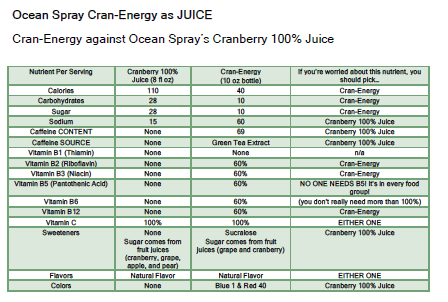
To the rushed shopper, Cran-Energy might pass as fancy cranberry juice. Comparing Ocean Spray’s Cran-Energy to Ocean Spray’s Cranberry 100% Juice, Cran-Energy IS NOT a healthy swap.

Capture2

Click here to open and download the Cran-Energy vs Cranberry 100percent Juice DATASHEET

While the Cran-Energy offers a cluster of B-vitamins, it also contains artificial colors and sweeteners that aren’t in the Cranberry 100% juice. Furthermore, consider the juice content itself! Looking at the front of the label, you might think Ocean Spray Cranberry 100% juice is 100% cranberry juice when in fact other fruits like grape, apple, and pear are also used to make this 100% juice. (When you can’t add plain sugar, grape juice is a very sweet natural source) Cran-Energy is only 23% juice and is mostly filtered water. If you wanted to reap the benefits of cranberry juice, Cran-Energy is not going to help you.

BOTTOM LINE

It’s short-sighted to call anything (even 100% juice) healthy because a term like this deserves context. With proper context, we can see that Cran-Energy IS NOT a healthy swap for 100% juice (let alone whole fruit), but it IS a healthy swap for the stereotypical energy drink.

~GreenEyedGuide

EXPLORE THE CAFFEINE INFORMER DATABASE

Support the GreenEyedGuide on Patreon
Visit the Energy Drink Guide Facebook page (sooo close to 100 Likes!)
Follow the GreenEyedGuide on Twitter
Follow GreenEyedGuide-the-NPC-Figure-Athlete on Instagram and Tumblr

Get your copy of “Are You a Monster or a Rock Star: A Guide to Energy Drinks — How They Work, Why They Work, How to Use Them Safely”