Science Behind Spider Energy Mimic

Summer is the best time to try new things, whether it’s exploring a new city or sampling new food. This month’s pick is one I wouldn’t normally try but felt compelled by the gorgeous design to give it a shot.

The Energy Drink of the Month for June 2015 is Spider Energy Mimic.

It’s just hitting stores now, June 2015, and a sugar-free version will be released later this year. (Check out this bold label – I can’t wait! I love the graphics!) No, this drink is not called Mimic because it is trying to mimic another energy drink that starts with letter M. If anything, the taste is closer to original Red Bull than original Rockstar or original Monster, but Spider Mimic is more tangy-fruity than either of those.

GREEN-EYED INSIGHT on SPIDER ENERGY MIMIC

What’s In It and Why?

This energy drink has no artificial colors or flavors, no high-fructose corn syrup or artificial sweeteners. It is sweetened with sucrose and glucose only, which accounts for its unique tart sweetness. If you are less concerned with overall sugar intake and more concerned about HFCS, and artificial colors/flavors/sweeteners, Spider Energy is more favorable than many other similar energy drinks. (No judgments – we all have different diet goals and needs)

Spider Energy Mimic Fact Panel

The B-vitamin complex is represented, but thankfully Spider does not go crazy with the amounts. Yes, B-vitamins are water-soluble but more isn’t always better (I’ve discussed the consequences of too much niacin or vitamin B6 elsewhere).

From a quality assurance/food safety perspective, I’m glad Spider Energy Mimic uses extracts (Panax Ginseng Extract, Guarana Seed Extract, Green Tea Extract). In general, extracts contain more of the active and less of the background (inherent microbial growth and heavy metal content).

I also love that this label opted to include a chart of the actives. That’s a great way to empower your consumers, letting them know exactly what actives are in your product, at what amounts. Speaking of empowering consumers, the details about what all these actives do is captured in the Energy Drink Guide; to avoid repeating myself or minimizing the years of work that went into said guide, I’ll just encourage you to check this guide out. It is the ultimate resource to all things energy drink and caffeine safety.

Who and What is This For?

This whole can provides 55 grams of sugar, which is too much for many people (including myself). But you can share with a friend or consume only half the can one day, saving the rest for later.

This whole can provides 240 milligrams of caffeine so, with the sugar content and carbonation, by the 5 Levels of Fatigue system, this product is a Level 4: a serious boost that’s best reserved for energy emergencies than for everyday consumption. If you’re working two jobs, if you’re pulling all-nighters to move out of your apartment by the deadline, or it’s your turn to stay up all night scouring the city and fighting crime, this drink is appropriate. If you consume this drink multiple times a week you may be getting your body too used to large amounts of caffeine.

NOTE – According to the European Food Safety Authority, a single dose of 200mg caffeine, with a daily maximum dose of up to 400mg caffeine is considered safe. But I personally recommend that caffeine consumers try to get by on as little caffeine as possible, so that when you REALLY need it, the caffeine will be able to do its job. This is what the 5 Levels of Fatigue is all about – finding the drink with the attributes that match how tired you are, preventing over-consumption and dependence.

Meet Your Friendly Neighborhood Spider Energy

Founded in 2009 under The Masters of Beverages, Spider Energy strives to be better than the “Big 3”. With a specific call-out to each on their main page, the main mission of Spider was captured perfectly in the following announcement from BevNet:

http://www.bevnet.com/news/2009/10-19-2009-spider_energy

 Bottom Line

Spider Energy Mimic is not for everyone. Energy drinks, in general, are not for everyone, but even this particular energy drink is not for all energy drink consumers. It has a cleaner ingredient line than many of its competitors, so if the sugar is too much for you (and my nifty little trick in the video above doesn’t appeal to you), I HIGHLY recommend seeking the Sugar-Free Mimic, coming soon.

REFERENCES AND RELATED LINKS
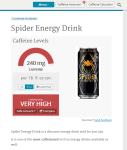
Spider Energy Home

From: http://www.caffeineinformer.com/caffeine-content/spider-energy-drink

Caffeine Informer on Spider Energy (click the image)

The Energy Drink Guide — your one-stop reference for the common energy drink ingredients: what they are, where they come from, what they (are supposed to) do, and how much is too much

Science Behind Celsius Energy

Based on recalls, litigation, adverse event reports, and consumer complaints, some of the riskiest product categories are energy drinks, weight-loss supplements and sexual health products. If you thought energy drinks got a lot of scrutiny in the press and by politicians, just image the pressure for a product that is both an energy drink and a weight loss supplement.  For those on quests to become more informed consumers, examining such a product is a wonderful, often enlightening exercise.  Moreover, May is the perfect month to examine such a product for two reasons: students are more likely to try new caffeinated products as they try to cram for finals; and figure-conscious individuals may be more likely to try a product they believe will help them reclaim their beach-ready body for summer. A product that is both an energy drink and a weight-loss product fulfills both types of curiosity.

The Energy Drink of the Month for May 2015 is Celsius Raspberry Acai Green Tea.

THREE-SIXTY DEGREES CELSIUS — Honest Product Review from Food Scientist, Gym Rat, Caffeine Aficionado

FIVE POINTS OF PRAISE

  1. One whole can is one whole serving. That makes it easier to understand EXACTLY what you’re getting and how much of it. No Portion-Distortion here.
  2. Though caffeine is part of the “Meta-Plus Proprietary Blend”, the amount of total caffeine IS stated on the can. One serving is one can, which offers 200 mg caffeine. This amount of caffeine is the maximum amount recognized safe as a single dose, according to European Food Safety Authority’s Scientific Opinion on Caffeine Safety. According to this study, 200mg doses don’t raise safety concerns even when consumed less than two hours before intense exercise.
    ***Note that healthy adults can have up to 400mg caffeine per day, and also please note it is never recommended to “chug” your energy drink [See Duh-Alert: AHA says chugging caffeine is bad for the heart]
  3. The amounts of vitamins aren’t crazy. I roll my eyes when I see mega-doses of Vitamin B12 (which doesn’t actually do anything unless you’re deficient), or any fortification with Vitamin B5 (which is in almost every food group imaginable so there’s no need to fortify). Some supplements go a little overboard with Vitamin B3, but over 35mg of this can make some people flush and itchy. The B-vitamins are water-soluble, but that doesn’t mean that more is better.

    Celsius Raspberry Acai Green Tea GreenEyedGuide
    Product Claims
  4. The product claims highlight the ways this product is different from the energy drink stereotype. Even their Warning Statement is grammatically correct: “Not recommended for people who are caffeine sensitive, children under 12, or women pregnant or nursing.” I can’t help but chuckle when I read a Warning Statement that says, “Consult with a healthcare professional if you are pregnant.” Gee, thanks for the tip, but I was going to ride these 9 months doctor-free and deliver in a bathtub. In contrast to the warning statement which offers general health advice and cannot be read literally, Celsius’s statement actually refers to the product.
  5.  The label makes it very obvious this product does not magically make your fat disappear. Celsius is your workout buddy, your “Ultimate Fitness Partner”, and it’s made clear in the side-panel Marketing blurb the product doesn’t work if you’re not exercising.

FIVE BURNS of Celsius – The NEGATIVE POINTS

  1. The words “clinically proven” makes me raise my eyebrows as a scientist. It’s actually rather difficult to clinically prove anything related to weight-loss because there’s always confounding factors. In this case, the increased metabolism, reduced body fat, and improved endurance are typical results of studies that make people exercise, especially if any type of caffeine is involved. It’s common knowledge caffeine improves athletic performance, but the magnitude of those improvements depend on whether the person is an athlete or a gym rat; an occasional coffee drinker or a coffee/tea-holic.
  2. The front of the can says, “Your Calorie-Reducing drink” and yet there is a supplement facts panel. A product is not allowed to have a supplement facts panel if it is referred to as a “drink” or beverage. If it is truly a drink, it must have a “Nutrition Facts” panel, while supplements need a “Supplement Facts” panel and have different regulations for the fact panel layout and content. This may not seem like a big deal, but there are countless FDA Warning letters to companies that demonstrate this product-category confusion.
  3. This product always dries my mouth out. This astringent effect is common with certain tannins in tea and Premium Brewed Green Tea is a predominant ingredient. Ginger root extract may also affect some people this way.
  4. While the amount of caffeine is stated, there are other components of the “Meta-Plus Proprietary Blend” that I would prefer to see itemized. For instance, how much taurine and green tea leaf extract? How much ginger root? The missing amounts don’t concern me as a consumer, but knowing those amounts would fascinate me as a scientist.
  5. Again, the diction grammar bothers me. The side panel of this product says “Celsius burns up to 100 extra calories and more.” How can you burn UP TO 100 calories AND MORE? Which one is it? Also, the expression “calorie reducing” isn’t exactly the same thing as burning calories, but Celsius, the “calorie reducing drink” is supposed to help one burn more calories. Add in the fact that a calorie is a unit measuring energy and the “calorie reducing drink” that gives one “lasting energy”, and we’ve got QUITE THE PARADOX!

BOTTOM LINE

Overall this is not my favorite product, but it’s one that I do enjoy from time to time. Since it’s not carbonated, it’s less likely to upset my stomach if I drink it en route to my morning workout. There is a decent kick from the caffeine, but as a science-nerd I get just as big a kick out of reading the label. There’s nothing wrong with the ingredients but the caffeine may be strong for some people. If this product and its calorie-reducing promises help you commit to going to the gym instead of going home or sleeping in, then it can be a great product to try at least once!

— GreenEyedGuide

Related Reading and Other Links

For more caffeine and energy drink information, don’t forget to find your copy of

ARE YOU A MONSTER OR A ROCK STAR? A Guide to Energy Drinks – How They Work, Why They Work, How to Use Them Safely

Energy drinks explained: ingredients, safety tips and consumption tricks. 

Science Behind Avitae Flavored Caffeinated Water

It’s not even fair to call this an energy drink, because it’s the purest, simplest, cleanest energy drink possible. It’s not fair because all the worry and legislation over the dangers of energy drinks can’t possibly apply to a product like this. This really shouldn’t be called an energy drink , and yet, this “energy drink in disguise” is exactly that.

With a nod to Earth Day (and the growing concern regarding California’s water crisis), the Energy Drink of the Month is flavored, caffeinated water by Avitae.

Avitae Caffeinated Flavored water
Tangy tangerine is my favorite.
Source: http://goavitae.com/products/

Pronounced “ah-vee-tay”, Avitae’s line of caffeinated waters is perfect for consumers who want their caffeine without added sugars or artificial colors/flavors.

Last year, Avitae’s President and CEO was gracious enough to answer some quality and food science questions I had about the non-flavored products (read that Q&A here). This year, Mr Norman Snyder was gracious enough to again grant me an interview to discuss the new flavors.

5 MORE Questions with Norman E. Snyder, President & CEO of Avitae USA, LLC

GEG-1: Last time we talked, you said that the plan was to introduce new flavors before looking at a carbonated product. Can tell me what inspired the new flavors? How did you determine which flavors to pursue, and were there any that were close but didn’t make the cut?  

NS: The inspiration came directly from consumers.  We do many sampling events at retail locations, festivals and other events that we believe attract our consumers.  The first comment made by the majority was “it does taste like water.”  The second comment/question was “do you have flavors?”  It was pretty easy from that point.  We did research on flavors that are currently popular and tasted several.  We initially narrowed the field down to six that we thought were great recognizing that we could only introduce three or four.  We selected the four best internally then conducted third party taste panels.  Ironically the four that we selected were also selected by the taste panels.  The two that did not make the cut maybe used in future products.

GEG-2: How long did it take to bring these new flavors from concept to market, and what was the biggest challenge?  

NS: Approximately six months.  The biggest challenge was, as perfectionists, getting exactly what we wanted.  That usually requires  several iterations as we were not willing to compromise on any point.

[GEG Note – Avitae has several part-time employees but only 16 full-time employees, so launching four new flavors in six months is pretty impressive, in my opinion]

GEG-3: The unflavored Avitae comes in three caffeine amounts: Energy Kick – 45mg, Energy Boost – 90mg, and Energy Blast – 125mg. I love this variability because there’s something for those more sensitive to caffeine, and something for those who need something a little stronger. How was it determined how much caffeine the new flavored versions should contain?  

NS: We are basically going after three consumptions occasions/products:  diet soda, coffee and energy drinks.  Each different strength is targeted at the people that use those products.  As 90 mg is presently the best selling product, we believed that strength to be the best choice.  Again, we listened to our consumers.

GEG-4: As Avitae’s President and CEO, what are you most proud of and what keeps you up at night?  

NS: I am most proud of our overall corporate philosophy and product positioning, in that we provide the healthiest solution for people that want a boost but also seek an alternative to the artificial, high sugar, and otherwise less than healthy products that exist today.  Many things keep me up at night but right now it is keeping up with demand of our products and growth.

GEG-5: What is Avitae’s next big hurdle/goal?  

NS: Expansion.  We are moving into several new markets and adding additional production facilities.  I admit, it is a great problem to have to face.  We are also considering several new products.

[GEG Note – to find the nearest location selling Avitae, try their store locator: http://goavitae.com/find-now/ ]


Huge thanks to Mr. Snyder and the whole Avitae team — keep up the good work!

Learn more about Avitae!


Bottom Line and Points to Remember

Great for those seeking a simple delivery of caffeine that’s portable, resealable, and not as likely to go flat in a hot car, Avitae’s line of caffeinated waters are healthy and effective alternatives to the typical energy drink.

Remember, according to the 5 Levels of Fatigue, Level 1 is dehydration. To limit caffeine dependency and overuse, make sure to try plain water before relying on caffeine to perk you up. Healthy adults should not exceed 400 mg caffeine per day but minors, pregnant/nursing women and those sensitive to caffeine all have different recommendations for caffeine intake maximums. [See caffeine intake guidelines in previous post]

Read more about the 5 Levels of Fatigue and learn how Biological Sensitivity and Consumption Specifics impact the effects of caffeine – Are You a Monster or a Rock Star: A Guide to Energy Drinks — How They Work, Why They Work, How to Use Them Safely (available through iTunes, Amazon, Barnes & Noble and more)

Visit/Like the Facebook Page: Energy Drink Guide

Follow @GreenEyedGuide on Twitter

Science Behind Swish4Energy Caffeinated Mouth Rinse

An energy drink you’re not supposed to swallow? I had to check this out for myself. This was an opportunity to experiment with something novel, and yet, this experience was something many consumers encounter at one point or another — suspicion of unfamiliar chemicals and ingredients.

Supplement Savvy Step ONE: Understanding the Product’s Purpose

Swish Energy is a unique product — it’s not exactly an energy drink because you’re not supposed to swallow it. It’s more of an energy mouthwash. This is a brilliant concept; it’s an untapped market. It’s true that some caffeine is absorbed sublingually (beneath the tongue), and this delivery system is less susceptible to the complaints the FDA had with the “caffeine inhaler” idea (read the FDA’s warning letter), or caffeinated gum (GEG rant here).

Step TWO: What to Ask BEFORE you buy

There are three questions you need answers to before you buy a new supplement. You may not always get the truth to these three questions, but asking them may eliminate some of the most shady products from your cart. First, figure out where the product is manufactured. Something “Made in the USA” might still be coming from someone’s basement, but at least that manufacturing location will be subject to FDA regulations. Yes, there are regulations for supplements, too.

Second, figure out who’s selling the product to you. If it’s a sales-person with no science background just reading a script, buyer-beware. If the product’s founders have a background in pharmaceuticals, chemistry or food science, that is better than someone who is just an entrepreneur with a Scientific Advisory Board. When the CEO is a scientist and not just a business-person, it’s more likely they’re going to make decisions based on food science.

Third, find a picture of the actual label — facts panel and ingredient statement. This is often the most important part, and will tell you more than any of the claims on the front of the label. Once you’ve got a picture of the facts panel and ingredient statement, you’re ready for Supplement Savvy Step THREE!

Step THREE: How to Research Unfamiliar Ingredients and/or Chemicals

As John Coupland once said, “I tried avoiding ingredients I can’t pronounce, but sadly I can pronounce them all.” Like Dr. Coupland, I understand the point behind the “pronounceable ingredients only” strategy, but I can’t take such advice seriously when I know so many people who can’t properly pronounce “acai” and “quinoa”.

Before you shell out your hard-earned cash on a new supplement, it’s worth your time to do a Google-search on the ingredients in the product you’re considering. BEWARE – there is a LOT of awful misinformation on the internet, so always look at multiple sources (the product’s own site and Wikipedia don’t count).  The more you populate your Favorites list with sites and sources you know are credible, the quicker and more reliable your search is going to be.

Review of Swish Energy, Ingredient by Ingredient

Science Behind Red Bull Total Zero Cherry and Orange

It’s an energy drink so powerful, just looking at it will get you pumped.

I always get excited when I come across a new energy drink, but when it’s by a company I have never heard of, that excitement is interwoven with suspicion and hesitancy. Though I am cautiously optimistic by nature, I am a scientist; I am trained to ask several questions before I form an opinion. All that hesitancy flies out the door when it comes to new flavors from a brand I know and trust. In this case, I didn’t even have to open the can to feel hyper.

The Energy Drink of the Month for March 2015 is a tie between Red Bull Total Zero Cherry and Orange Editions.

THREE REASONS TO GIVE RED BULL ANOTHER LOOK

ONE—Red Bull is Number One

One of the major reasons Red Bull deserves to be the energy drink of the month is that March is Caffeine Awareness Month. Did you know that Red Bull is the number one selling brand of energy drinks? Did you know that its caffeine content is less than the second and third top-selling brands? Compare Red Bull’s 80 milligrams per 8.4 ounce can with Monster’s 140-160mg/16oz and Rockstar’s 160-240mg/16oz. Two huge benefits Red Bull has over these other two brands are its smaller size and lower caffeine content. Together, these two details make Red Bull better options for those looking to keep their caffeine content in check. Though Monster’s zero sugar versions feature about 70mg per serving, the standard size features two servings per can. This packaging decision can make many consumers feel obligated to consume the whole thing, which can lead to caffeine over-consumption.

http://www.caffeineinformer.com/the-15-top-energy-drink-brands

TWO—Bull, meet Elephant (in the Room)

What do Red Bull and March have in common? They both involve heavy consumption of alcohol. Another reason Red Bull deserves to be Energy Drink of THIS particular month is that St. Patrick’s Day is associated with copious amounts of alcohol. The same can be said for Red Bull.

It’s hard to deny that drinks like Vodka Red Bull are partially responsible for Red Bull’s amazing sales figures. An excerpt from Caffeine Informer’s article “Alcohol and Energy Drinks: The Dangers of Mixing” summarizes why this combination is such a bad idea:

A study out of Wake Forest Medical Center has been looking into this energy drink mixed with alcohol fad in order to see what negative effects it has created. The study revealed the following;

  • Students who drank the mix were likely to become more intoxicated and become intoxicated twice as often.
  • Students were twice as likely to be injured on this concoction.
  • They were twice as likely to ride with a drunken driver.
  • They were also twice as likely to be taken advantage of sexually or take advantage of someone else.

The researchers believe that the high doses of caffeine mask your body’s natural ways of letting you know you’ve consumed too much alcohol, therefore, people tend to drink way more than they should.

Every good bartender knows giving caffeine to a drunk just makes them a wide-awake drunk, not any less impaired (or annoying). Your body has a built-in safety mechanism: when you’ve had too much to drink, you pass out. This is the body’s way of saying, “You’ve had ENOUGH!” When you throw caffeine in the mix, you bypass this safety mechanism and can literally drink yourself to death. Part of Caffeine Awareness Month is knowing when NOT to have caffeine.

For some, the strongest disincentive to combine alcohol and caffeine is that it impairs the reflexes as much as non-caffeinated alcohol would, but the caffeine masks the fun parts of being tipsy– the dizziness, the giggle-fits, the false sense of confidence, etc. In other words, combining caffeine and alcohol is a waste of alcohol (and caffeine!).

THREE—Inspiration from Rags to Riches and Wi-ings

Though there are plenty of great stories behind other energy drink brands, the story behind Red Bull’s creator is one I relish. Chaleo Yoovidhya was born into poverty but died in March 2012 as the third-richest man in Thailand. As the co-creator of Red Bull, his rise to success brings new meaning to the slogan “Red Bull gives you wings”. As we approach “Bonus Season” and “Tax-Refund Season”, some people start thinking about their financial situation and how to change it. This month of financial re-calibration is a great time to think about the man who co-created Red Bull, and his escape from poverty.

BOTTOM LINE

While Red Bull does not have the cleanest, most natural ingredient line like some of the other Energy Drink of the Month picks, Red Bull is the best pick for Caffeine Awareness Month. Its size and caffeine content make it a better option than some of the other popular energy drinks, as long as it is never, ever, EVER combined with alcohol.

— GreenEyedGuide

Related Reading and Other Links

For more caffeine and energy drink information, don’t forget to find your copy of

ARE YOU A MONSTER OR A ROCK STAR? A Guide to Energy Drinks – How They Work, Why They Work, How to Use Them Safely

Energy drinks explained: ingredients, safety tips, and consumption tricks.