Science Behind Ocean Spray Cran-Energy

If your New Year’s Resolution is to consume fewer energy drinks, you may be looking for some healthy swaps. How healthy is fruit juice, really? Obviously, it’s not as healthy as whole fruit, but usually healthier than soda. This energy drink (alternative) of the month is a healthy alternative to the stereotypical energy drink, but it is also an example of how “healthy” and “good for you” is a matter of context and perspective.

The Energy Drink of the Month is Cran-Energy Cranberry Energy Juice Drink.

On their own page, Ocean Spray’s clever distinction, “energy JUICE drink” highlights the ambiguity of how to classify this product. Since this product walks the line between the JUICE category and the ENERGY DRINK category, we’ll compare how healthy this product is relative to other products in each category.

Is it Juice or an Energy Drink? Product Category Confusion

If it was your job to tally the annual sales of different types of beverages, would you put this in the “energy drink” category or the “juice” category? In their article “Juice Gone Wild”, the Center for Science in the Public Interest has effectively put this in the juice category. However, on their own site, Ocean Spray compares this product to “other energy drinks”. Furthermore, BevNet’s product assessment definitively puts this drink in the energy drink category as this product was specifically designed to give people energy.

Cran-Energy versus the stereotypical ENERGY DRINK

Since Red Bull is the number one selling brand in the ENERGY DRINK product category, we’ll compare Cran-Energy to Red Bull.

Capture

Click here to open and download the Cran-Energy vs Energy Drink DATASHEET

Against a stereotypical energy drink, Cran-Energy IS a healthy swap. The 2015-2016 Dietary Guidelines for Americans (DGA) recommends sodium intake not exceed 2300 mg per day. With such a low limit, the lower sodium of Cran-Energy is a healthier option than Red Bull.

Furthermore, the 2015-2016 DGA recommendation is to limit intake of added sugars (like those in the Red Bull) to less than 10% of total calories per day [Source – FoodInsight.org].  It’s also important to note that since the sugars in the Cran-Energy come from grape and cranberry juice, they’re not TECHNICALLY “added sugars” because they’re natural in grape juice. (Though grape juice isn’t naturally added to cranberry juice, is it? Hello, loophole!)

But what about the Sucralose in Cran-Energy? The 2015-2016 DGA agrees with leading global authorities including the European Food Safety Authority that sweeteners like sucralose are safe to consume, though the DGA does note that “replacing added sugars with high-intensity sweeteners may reduce calorie intake in the short-term, yet, questions remain about their effectiveness as a long-term weight management strategy.” [Source – FoodInsight.org].

Cran-Energy versus Cranberry JUICE

To the rushed shopper, Cran-Energy might pass as fancy cranberry juice. Comparing Ocean Spray’s Cran-Energy to Ocean Spray’s Cranberry 100% Juice, Cran-Energy IS NOT a healthy swap.
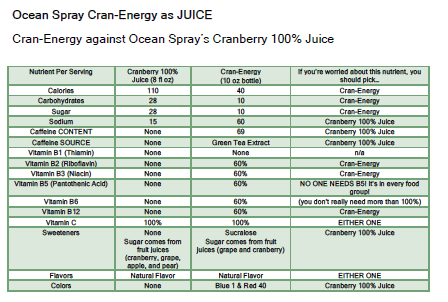
Capture2

Click here to open and download the Cran-Energy vs Cranberry 100percent Juice DATASHEET

While the Cran-Energy offers a cluster of B-vitamins, it also contains artificial colors and sweeteners that aren’t in the Cranberry 100% juice. Furthermore, consider the juice content itself! Looking at the front of the label, you might think Ocean Spray Cranberry 100% juice is 100% cranberry juice when in fact other fruits like grape, apple, and pear are also used to make this 100% juice. (When you can’t add plain sugar, grape juice is a very sweet natural source) Cran-Energy is only 23% juice and is mostly filtered water. If you wanted to reap the benefits of cranberry juice, Cran-Energy is not going to help you.

BOTTOM LINE

It’s short-sighted to call anything (even 100% juice) healthy because a term like this deserves context. With proper context, we can see that Cran-Energy IS NOT a healthy swap for 100% juice (let alone whole fruit), but it IS a healthy swap for the stereotypical energy drink.

~GreenEyedGuide

EXPLORE THE CAFFEINE INFORMER DATABASE

Support the GreenEyedGuide on Patreon
Visit the Energy Drink Guide Facebook page (sooo close to 100 Likes!)
Follow the GreenEyedGuide on Twitter
Follow GreenEyedGuide-the-NPC-Figure-Athlete on Instagram and Tumblr

Get your copy of “Are You a Monster or a Rock Star: A Guide to Energy Drinks — How They Work, Why They Work, How to Use Them Safely”

Science Behind Mate Bros Yerba Mate Energy Drink

Mate Bros yerba mate energy drink is no longer manufactured, but it is another example of how not all energy drinks fit the Red Bull stereotype. Still, there’s a lot to learn by looking at the ingredients, especially since there are still plenty of yerba mate energy drinks on the market.

For a more complete list of other Yerba Mate based drinks, check out this blog from Yerba Mate Culture.

Did you know sleep-deprivation makes it harder for us to connect with others? Sleep-deprivation lowers our Emotional Intelligence, meaning we struggle to keep our own emotions in check and struggle to read the emotional cues of other people.

But what if an energy drink could help you connect with others?  It’s this spirit – and the spirit of the holiday season – which inspired this pick for the Energy Drink of the Month review.

The Energy Drink of the Month for December 2015 is Mate Bros Yerba Mate.

mate bros yerba mate energy drink

Mate Bros yerba mate energy drink is another “energy-drink-in-disguise” because it doesn’t fit the energy drink stereotype. To understand all the ways this energy drink is different, let’s explore the ingredients in this “Natural Energy Brew”.

Mate Bros Energy Drink Ingredients

Mate Bros yerba mate energy drink ingredients

This product has only six ingredients. SIX! This is definitely a selling point for people who don’t like the stereotypical energy drink with “chemicals” and unpronounceable ingredients.  Mate Bros energy drink ingredients are water, sugar, lemon juice from concentrate, yerba mate leaf extract, reb A (stevia), and natural flavor.

Let’s take a closer look at these ingredients:

Water

This is a non-carbonated product, which means it’s closer to being a tea than a stereotypical energy drink. The fact it’s non-carbonated also makes it a very low Fatigue Level 2 drink in the 5 Levels of Fatigue system

  • As a reminder, the 5 Levels of Fatigue is a system for finding how much caffeine you need based on how tired you are.

Sugar

Only 6 grams, and just plain sugar, not any of its acronyms.

Lemon Juice from Concentrate

This is the source of the 10% vitamin C and the 8% juice on the facts panel. In this case, lemon juice is not just for flavor, it’s a natural preservative. The acidity of the lemon juice makes it hard for bacteria and mold to grow. Note the absence of any other preservative in the ingredients list. 


Caffeine Informer Mate Tea

Yerba Mate Leaf Extract

According to the Mate Bros label, the Yerba Mate inside provides 99 mg caffeine per serving (per can). This is consistent with the content of Mate Tea, according to Caffeine Informer’s massive database (see Caffeine Informer image, above)

    • For more information about where yerba mate comes from and how it differs from other sources of caffeine like green tea and guarana, get your copy of the Energy Drink Guide:
      Energy Drink Book - fan photo Energy Mafia

Reb-A (Stevia)

Stevia is a natural sweetener. The term “Reb A” is the name of the molecule extracted from the leaf of the Stevia plant that delivers the sweetness.

    • Did You Know: Stevia can be tricky for product developers because it’s critical to find a good source. Not all Stevia tastes the same, and a poor quality source may leave some people with Stevia’s characteristic bitter-metallic aftertaste.

Natural Flavor

Since there is no indication on the label what flavor this product is supposed to be, I have no idea what this natural flavor is…maybe lemon?

    • I’m not alone in my confusion: when BevNet reviewed this product, they gave it 3 out of 5 stars and expressed disappointment that there was only one (ambiguous) flavor variety available.

Final Thoughts

With the amount of caffeine in this product and the very simple ingredient list, this is a very nice substitute for a weaker energy drink. Note, Red Bull has 80 mg caffeine per 8 oz can, and this product has 99 mg. What a nice healthy swap, right?


Related Resources:

If you’re interested in yerba mate specifically, you might enjoy these posts by Yerba Mate Culture:


Everything you’ve ever wanted to know about energy drink safety and ingredients – now in paperback, hardcover, eBook, and Audible!

energy drink book on audible

Sugar Free Energy Drink Comparison – Spider Energy vs Rockstar vs Monster

In this post, we take a close look at the ingredients in sugar free Spider Energy in comparison to similar products from Monster Energy and Rockstar Energy. Our deep-dive comparison includes the ingredients used, their function, and whether any of these are better for people trying to avoid certain ingredients.

Sugar Free Energy Drink Comparison: Spider Energy, Rockstar Energy, and Monster Energy

What We’re Comparing

  • Ingredient Line Deep Dive
    • Which ingredients are used and why?
    • How similar are the ingredients?
  • Bottom Line and Biggest Differences
    • Are any of them better or worse for people trying to avoid certain ingredients?

Ingredient Line Deep Dive includes:

  • Ingredient Order
  • Caffeine Content
  • Vitamin Dosage
  • Other Actives (ginseng, guarana, carnitine, etc.)
  • Sweetness Profile
  • Other Ingredients (colors, thickeners, preservatives, etc.)

Thank you all!

Science Behind Nawgan Energy Drink

Partially inspired by the movie Iron Man 3 and partially due to this summer’s hot weather, I’ve chosen Nawgan Mandarin Orange as the Energy Drink of the Month for July 2013.

For any caffeinated beverage, the following 10 attributes are key to assessing the drink’s potency and value. Let’s go through this exercise with Nawgan’s Mandarin Orange.

1. CAFFEINE CONTENT:
Caffeine content is stated on the label – 100mg caffeine per can (11.5 ounces)
This is amount is less than the amount of caffeine in a tall iced coffee from Starbucks (120mg).
 Energy Fiend Complete Guide to Starbucks Caffeine

2.  SERVING SIZE AND SERVINGS PER CONTAINER:
One serving is one whole can, which makes it easy to regulate the amount of caffeine one consumes.

3. NUTRITION OR SUPPLEMENT FACTS PANEL:
This product has a Nutrition Facts panel, which means it’s a beverage, not a supplement. That means this product is subject to food/beverage regulations, not the supplement regulations (What? Supplements are regulated? Yes, despite what you may here elsewhere, supplements ARE regulated by the FDA, just using a different rule book than the one used for food/beverage products).
Since this has a Nutrition Facts panel, you know all the ingredients used within are either GRAS (Generally Recognized As Safe) or approved food additives.

4. RECOMMENDED USE:
Since this product is a beverage, not a supplement, it’s unusual to find Recommended Usage or Warning information. Some caffeinated beverages still bear the Warning Label, but this beverage does not. With only 100mg caffeine, this isn’t surprising.

5. FIRST INGREDIENT:
The first ingredient in this product is filtered water, not carbonated water. Carbonation irritates the stomach lining which speeds up the absorption of certain molecules like alcohol and caffeine. This is why champagne seems to affect one’s sobriety more rapidly than beer does.

6. SWEET STUFF:
This product has 11 grams of added sugar so those of you watching your sugar intake may want to opt for the sugar-free Nawgan products.  This product also has Erythritol, a sugar alcohol that’s captured the interest of food scientists for its reported ability to improve oral health.
New clinical trial indicates erythritol’s superior dental benefits
Notably, this product is also sweetened with Stevia, not any artificial sweeteners.

7.  VITAMIN B-12:
Vitamin B-12 plays a key role in maintaining healthy cells and DNA throughout the body. This product has 50% of the Daily Value of B-12, a respectable amount. There is no known upper intake level for B-12, meaning you can’t ever have too much, but there’s no reason anyone without a clinically diagnosed B-12 deficiency or absorptive disorder needs over 100% DV in one product.

8. VITAMIN B-6:
Vitamin B-6 participates in over 100 chemical reactions in the body, most of them involving amino acids and proteins. This product has 50% of the Daily Value of B-6, which is a good amount. A deficiency in B-6 makes it harder for blood cells to carry oxygen properly, so it’s important to get enough of the vitamin every day. However, intakes over 100 milligrams ( 5,000% DV) can cause nerve damage.

9. FOLIC ACID – This product has no folic acid, which isn’t a bad thing at all. It would only be bad if the product had more than 100% DV folic acid because that could mask a B-12 deficiency.

10. NIACIN – This product has no niacin, which isn’t a bad thing either. It would only be bad if the product had more than 35 milligrams of niacin (175% DV) because that could bring on the “niacin flush” – symptoms of flushing and itching.

BONUS POINTS:
This drink gets bonus points for the ingredient that makes it (and all other Nawgan beverages) special. Citicoline has been used in numerous studies assessing cognitive health and especially cognitive decline with diseases such as Alzheimer’s disease. A double-blind, placebo controlled (aka legit) study involving healthy participants showed that daily supplementation with citicoline improved cognitive function and performance. That study can be found here:
Improved Attentional Performance Following Citicoline Administration in Healthy Adult Women

BOTTOM LINE:
The amount of caffeine in this product and the lack of carbonation make this product a good match for Fatigue Level 3 (Read more about the 5 Levels of Fatigue in ARE YOU A MONSTER OR A ROCK STAR: a guide to energy drinks).

This drink is perfect for those mornings when a cup of tea or a glass of water isn’t enough to wake you up, but you don’t need a high-powered shove of caffeine to push you through an all-nighter or a graveyard shift. Moreover, whether or not this citicoline brain-booster actually works, the drink is energizing, sweet and refreshing – perfect for a hot summer day.

Nawgan.com: Mandarin Orange – product page